Lang101
65 views
July 29, 2026
For now, the app version of Lang101 is in alpha testing, do message me if you would like to join!
A first Android bundle is already openly available, while iOS has more security requirements for sharing builds with users. But, in the meantime, Lang101 is also available through a web interface.
I'm happy to announce the release of my first mobile app in a long while, an idea I had been brewing for a long time, out of my frustrations with language learning apps and overall ecosystem.
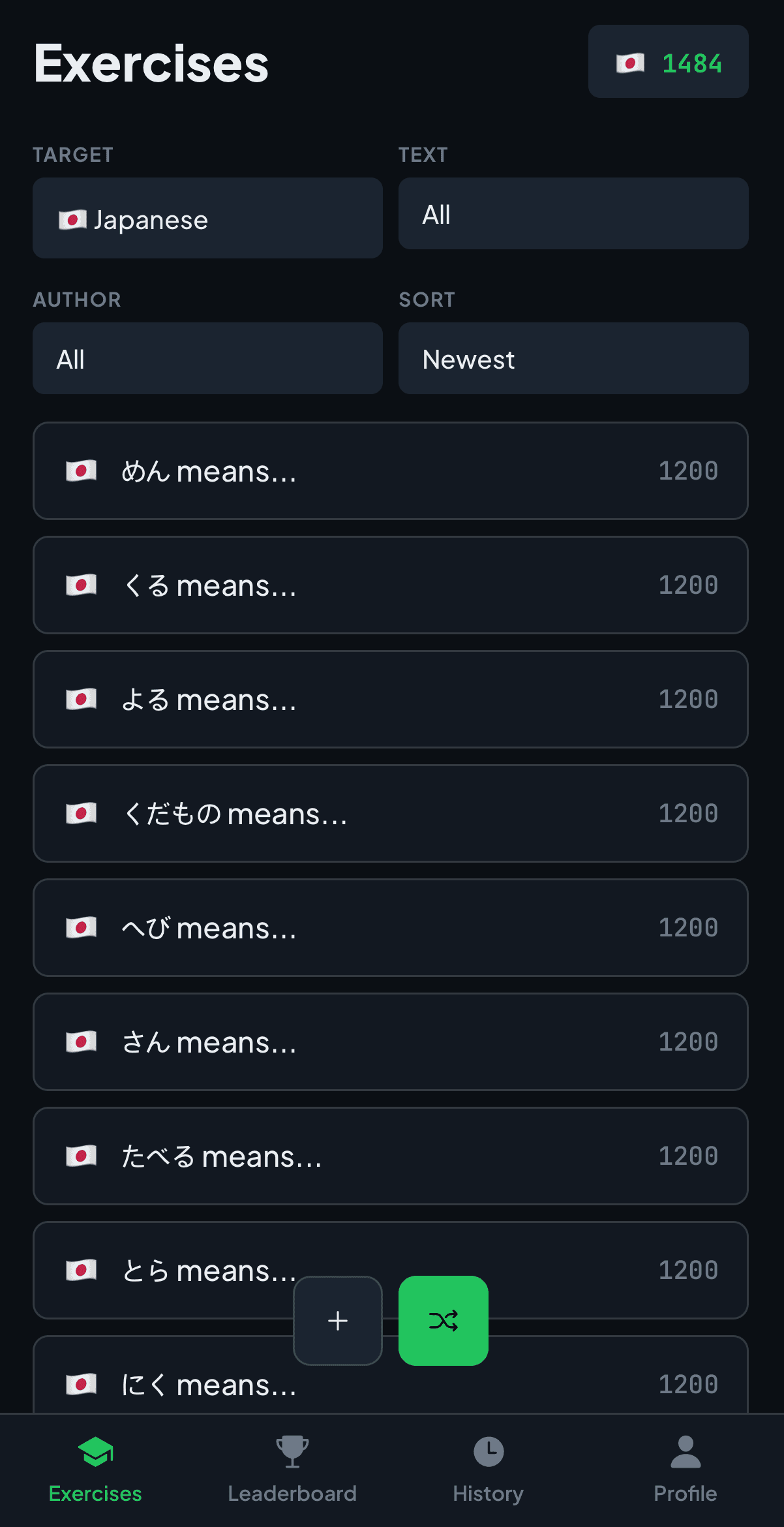
The "Exercises" page on Lang101.
Lang101 is the fusion of :
I've also taken quite a bit of inspiration from 101weiqi, a popular website for practicing Go (board game) problems.
Lang101's landing page. For now, I'm using this website's logo as a placeholder.
A statistical rating system is self-adjusting, while in practice mode, both the student's and the exercise's ratings get readjusted proportionally to relative difficulty. If the exercise is supposedly too easy for the student, if the student fails it, the rating penalty is big while the exercise also gets a large boost to its rating. On the other hand, if the student solves it correctly, only a few points will be earned.
By avoiding a dependence on instructors to level problem difficulty, not only do we relieve ourselves from a clunky burden, but create a more engaging experience, as we get challenges which reflect the real world much more closely.
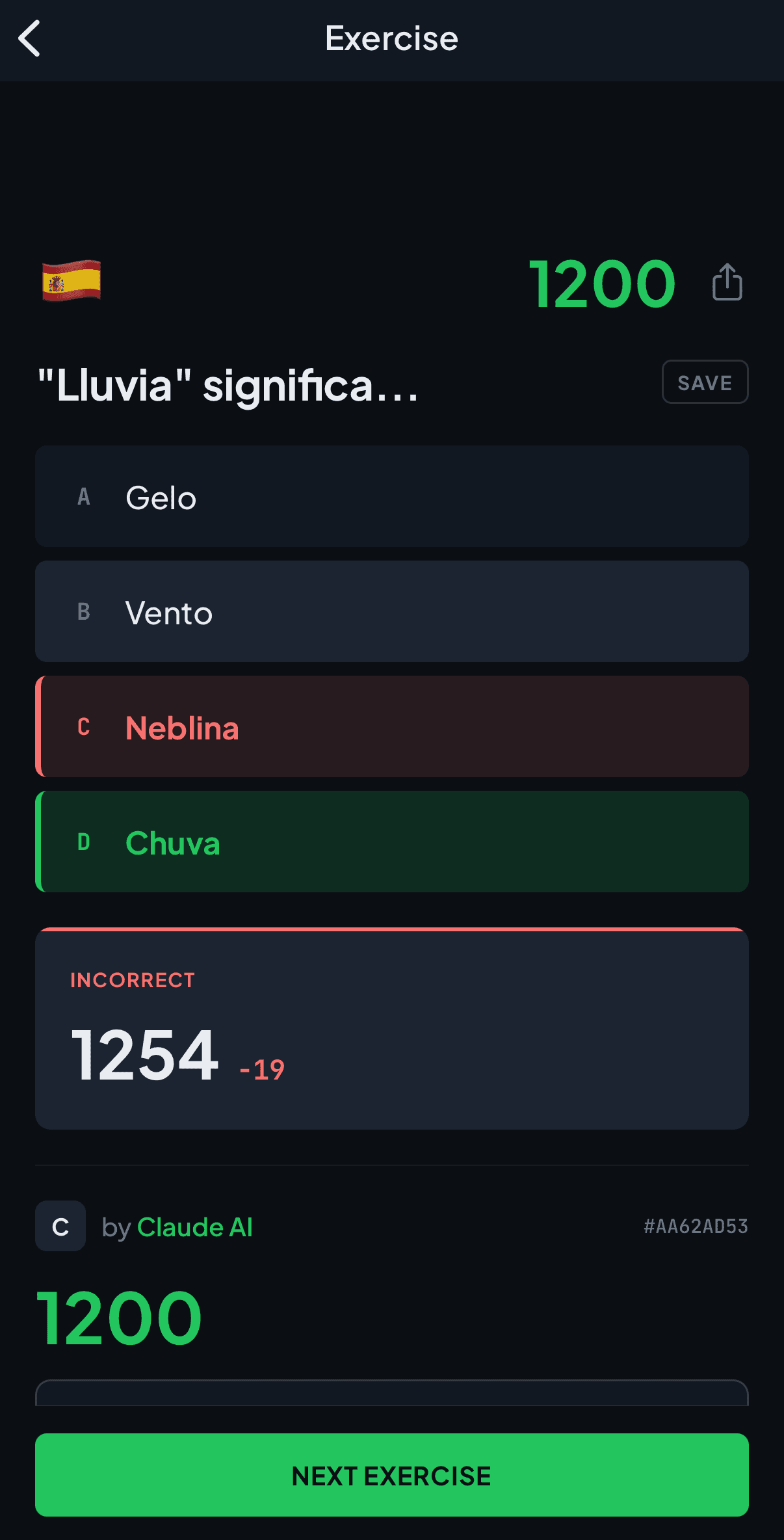
The student loses 19 points for solving a problem incorrectly. The 19 points are based on his Elo rating prior to the question, if that rating had been higher, an even bigger penalty would be applied.
Anki does feature a rating system, typically based on the user's difficulty in recalling an answer. However, I find that quite lacking in terms of granularity, very subjective, and quite tiring, as not only will you have to practice the cards but also worry about how to classify your results.
Besides the key feature of a rating system, Lang101 also offers:
- Per-language question filtering
- Per-language question prompt filtering
- Leaderboards
- History of solved exercises
- Comments on exercises
- Ratings on exercises
- Rating graphs
- Exercise list creation
- User following
- User messaging
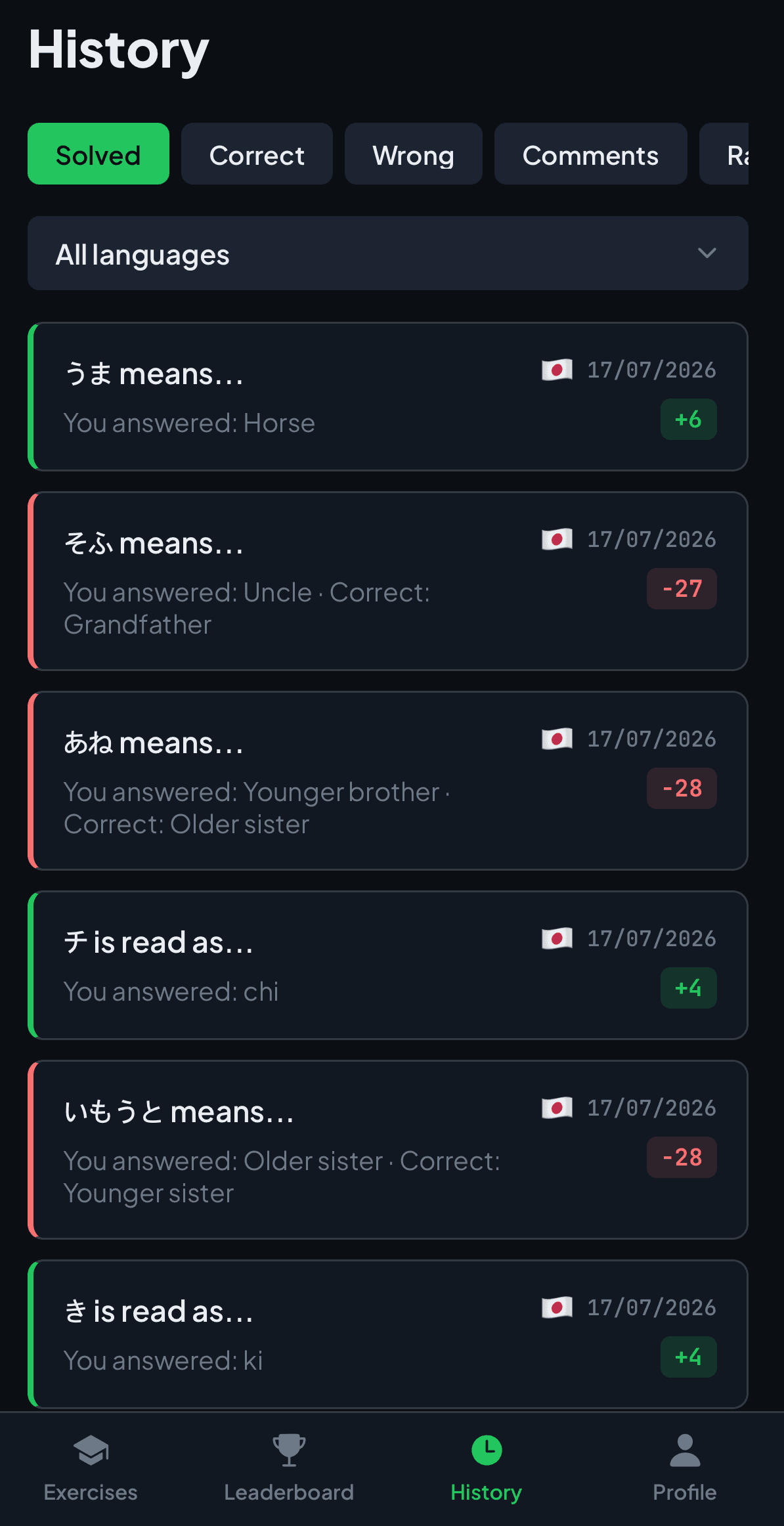
Lang101's "History" page, on dark mode.
The current version of the app also offers exercise variety, which will only increase over time:
- Multiple choice
- Type the answer
- Listening to a (YouTube) video
I have plenty more features in line for the near future, such as a multiplayer mode and better integration with Anki decks.
At the moment, as a first seed, a lot of the questions have been either created by AI, or batch-transcribed by it, based on open-source Anki decks. But, as the community gets bigger, the human-created percentage will hopefully increase.
One future leap for the app would be having AI monitor the student's progress and then create exercises on the go based on his or her difficulties. That might become a paid subscription service though, as AI services are currently not free.
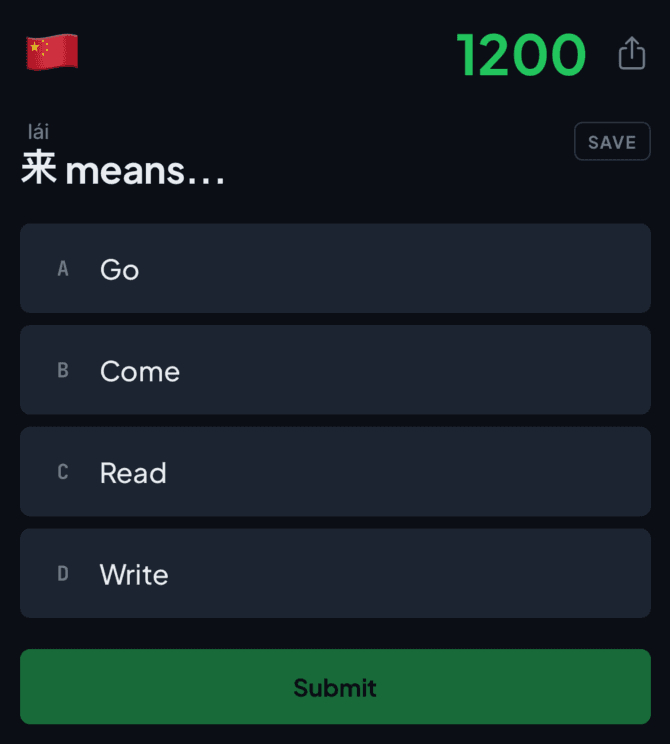
For languages such as Chinese and Japanese, even for native speakers, it's very common for text to have a top row guiding the pronunciation of a symbol. That feature is already present in Lang101.
Anki (暗記) means "learning by heart" or "rote memorization" in Japanese, and its respective software was created by an Australian programmer, Damien Elmes, to learn, you guessed it, Japanese. The flashcard approach is very helpful for East Asian language-learning, as so much of their languages is based on and compacted into many different symbols, as opposed to deconstructed with an alphabet. However, I think we could also deconstruct many, more complex concepts and topics into bite-sized exercises too, and that's my bet with this app. Let's see if it pans out!
Should I rename the app as "Lanki" at this point?
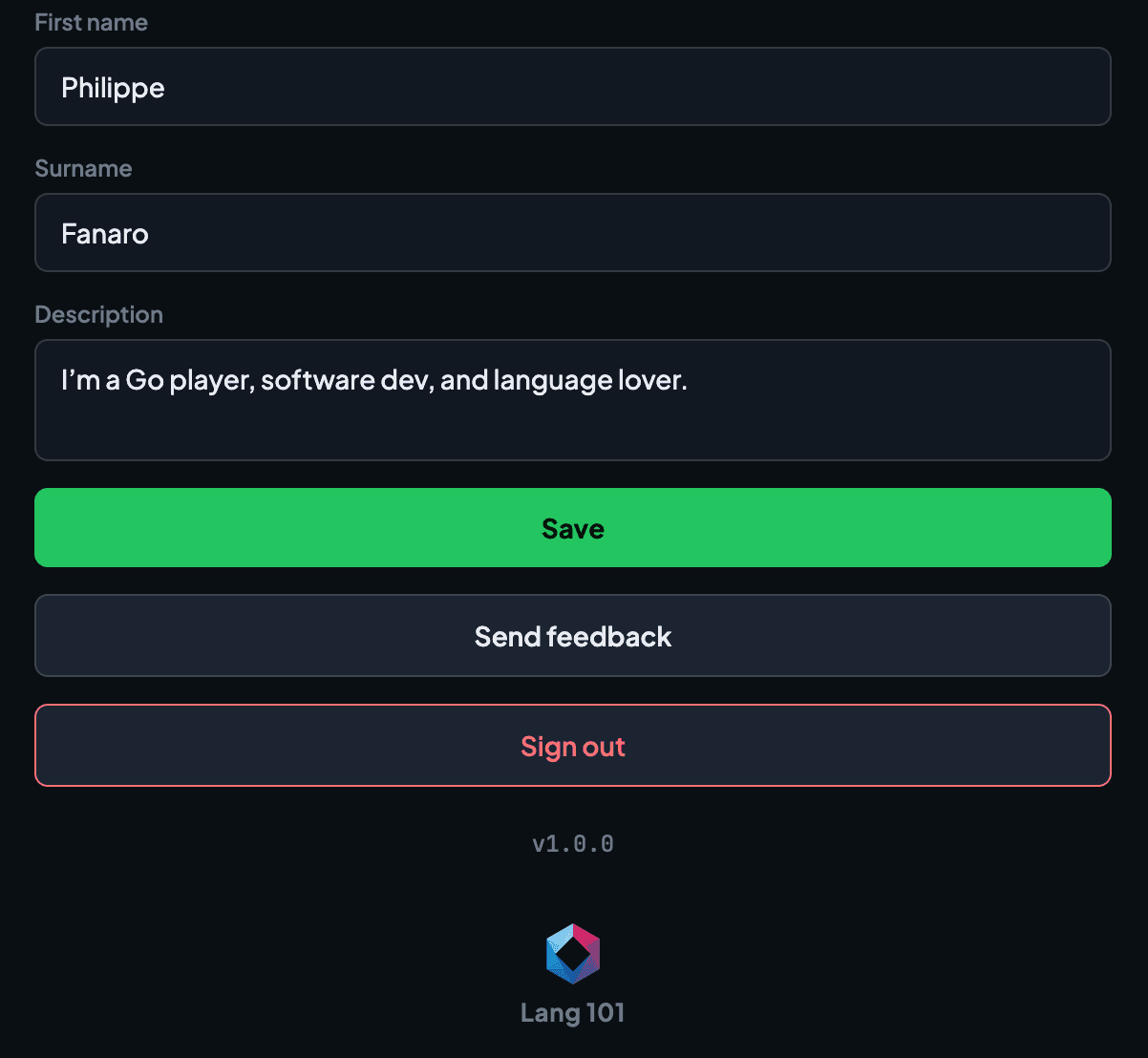
The profile page features a "Send feedback" button. Do share your thoughts and suggestions with me!
On Developing Lang101 (with AI)
Lang101 was almost entirely developed with Claude Code, using React Native. It is quite shocking how good the baseline paid model, Sonnet, is.
I did have to use my software know-how in order to get the app to where it is, so it wasn't a pure "vibe coding" project. Claude is incredibly skilled at programming, and DevOps as well, if I had to program this app myself, I could easily see the whole process stretching on to 3+ months. Instead, the bulk of it took me only a couple of weeks — plus a week or two to get through Apple's and Google's obnoxious verification processes for newly created developer accounts.
Claude Code, however, does not do well when it comes to UI design. Even after installing specific AI Skills, the results were disappointing. For handling the visual aspect of an app, I suggest using Claude Design. After refining the UI there, you're gonna be able to ask Claude to export resulting design as a document, such that Claude Code can implement it more or less precisely.
Coming from a more than year-long hiatus, I feel quite frightened for the software development as a profession. Overall, I would much rather spend most of my time doing top-level work rather than in the muck of lower level code, either writing or debugging things. But how many openings for product managers will there be in the future if all programmers need to move into that market?
In the meantime, at least, even our billionaire trillionaire overlord(s) might be starting to become aware we need to get past the wage economy:
Comments
You need to sign in to comment.
No comments yet.